Edvard Munch Madonna
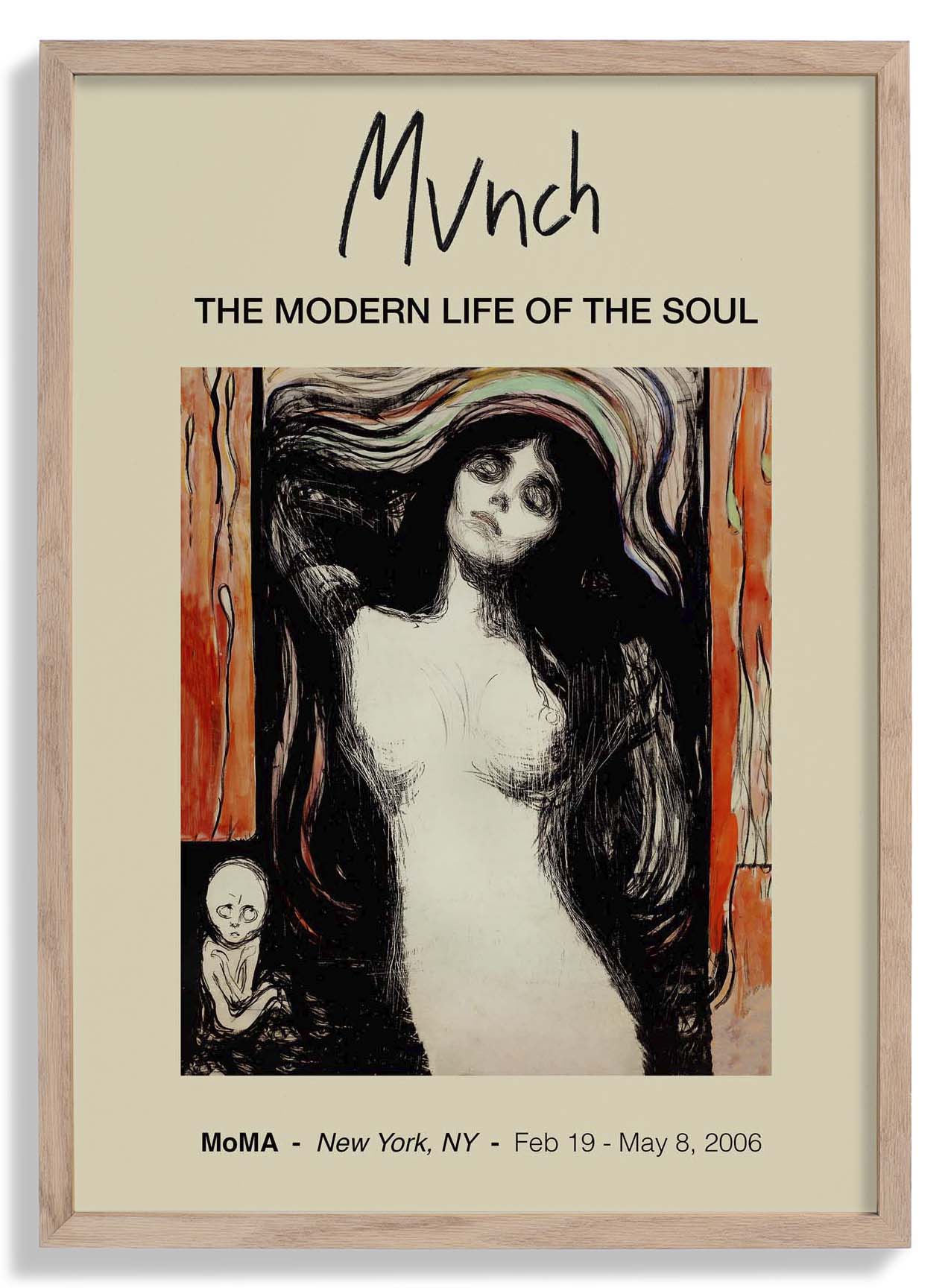
Munch's Madonna is one of the most psychologically charged images in Western art — a figure at once serene and unsettling, the halo dissolved into flowing dark hair, the eyes closed in an expression that sits between ecstasy and absence. The composition curves inward, almost enveloping the viewer, while the surrounding border of spermatozoa and a skeletal foetal form charges the image with themes of life, desire, and mortality. Painted in the mid-1890s at the height of Munch's Symbolist period, it remains a work that refuses easy reading, demanding return.
Rendered as an archival fine art print, the subtle tonal gradations of Munch's palette — those deep reds and oceanic blacks — are captured with the precision this painting requires. Fine detail holds sharp, and the matte surface keeps the work's brooding atmosphere fully intact.
Munch's Madonna is one of the most psychologically charged images in Western art — a figure at once serene and unsettling, the halo dissolved into flowing dark hair, the eyes closed in an expression that sits between ecstasy and absence. The composition curves inward, almost enveloping the viewer, while the surrounding border of spermatozoa and a skeletal foetal form charges the image with themes of life, desire, and mortality. Painted in the mid-1890s at the height of Munch's Symbolist period, it remains a work that refuses easy reading, demanding return.
Rendered as an archival fine art print, the subtle tonal gradations of Munch's palette — those deep reds and oceanic blacks — are captured with the precision this painting requires. Fine detail holds sharp, and the matte surface keeps the work's brooding atmosphere fully intact.
Original: $17.65
-65%$17.65
$6.18Description
Munch's Madonna is one of the most psychologically charged images in Western art — a figure at once serene and unsettling, the halo dissolved into flowing dark hair, the eyes closed in an expression that sits between ecstasy and absence. The composition curves inward, almost enveloping the viewer, while the surrounding border of spermatozoa and a skeletal foetal form charges the image with themes of life, desire, and mortality. Painted in the mid-1890s at the height of Munch's Symbolist period, it remains a work that refuses easy reading, demanding return.
Rendered as an archival fine art print, the subtle tonal gradations of Munch's palette — those deep reds and oceanic blacks — are captured with the precision this painting requires. Fine detail holds sharp, and the matte surface keeps the work's brooding atmosphere fully intact.